HEALTH.LONDON
Diagnostics

What is measured, why,
and what it cannot tell you.

Every modality below is listed with its limitations attached, because a programme that only publishes the upside is not one you should trust with a decision.

Continuous telemetry

The instruments you live with

A blood panel is a photograph taken twice a year. These are the instruments that fill the eleven months in between — supplied by the practice, enrolled to your record, and read alongside everything else rather than in a consumer app.

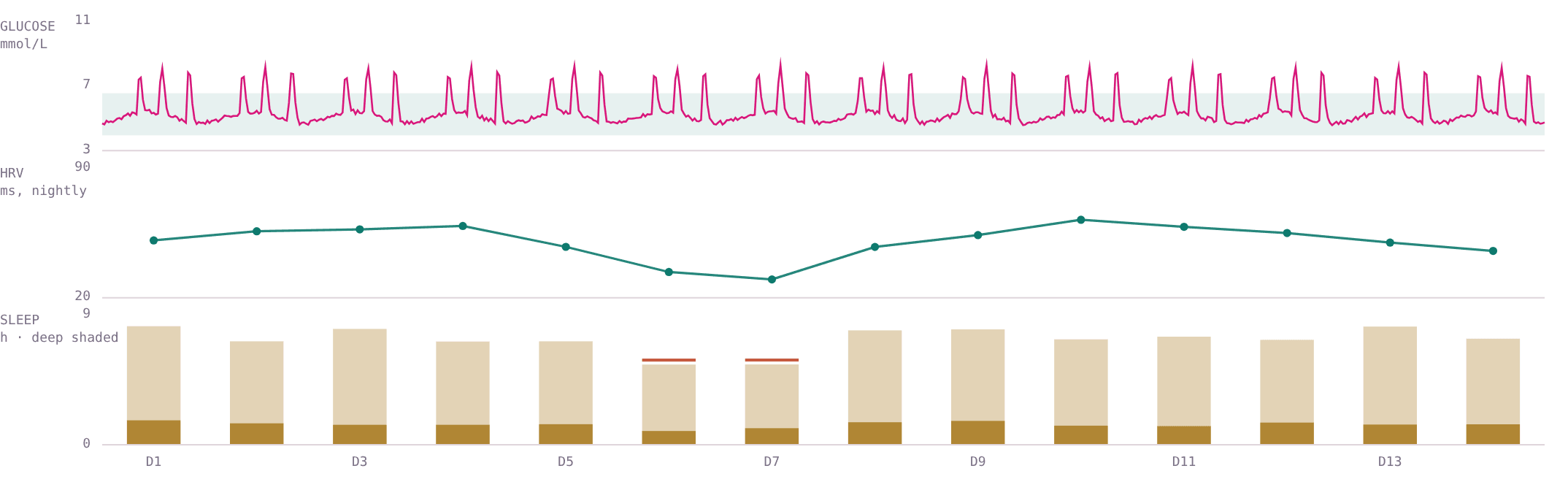
Fourteen days of continuous glucose, heart-rate variability and sleep data on a shared time axis
Fig. 01 — Fourteen days of continuous telemetry Illustrative · Days 6–7: short sleep, HRV suppressed, glucose variability up
Metabolic

Continuous glucose monitoring

Sensors supplied and replaced on schedule for the life of your membership. Read for variability, post-prandial excursion, overnight baseline and the dawn rise — never for the mean alone, which is the one number that hides everything interesting. A single meal's response tells you more about your insulin sensitivity than a fasting glucose ever will.

Composition

Home body composition

A home device of the practice's choosing — a Hume Body Pod or an equivalent we have validated — supplied, installed and calibrated where you actually live. Its absolute accuracy is well below DEXA and is never quoted as if it were equivalent. Its value is frequency: DEXA anchors the number twice a year, the home device tracks the direction daily in between.

Autonomic & sleep

Ring-based monitoring

An Oura ring or equivalent, supplied, sized and replaced on a stated cycle. Resting heart rate, heart rate variability, respiratory rate, skin temperature deviation, and sleep timing and staging. Read as a trend, and as one of the earliest available flags for incipient illness, alcohol load, and training you have not recovered from.

Vascular

Ambulatory blood pressure

Twenty-four hour monitoring at each review point, including nocturnal dipping status. Clinic blood pressure is among the least reliable measurements in medicine; the overnight profile is among the most informative, and almost nobody outside a hypertension clinic ever measures it.

Pipeline

One record, not four apps

Devices are enrolled to the practice account with your written consent, and the streams land in the same record as your panels — so a glucose pattern is read next to your fasting insulin and your HbA1c, and a fortnight of poor sleep is read next to your morning cortisol rather than in isolation.

Cadence

Reviewed by the team, monthly with Dr. Mittal

A named member of the clinical team reviews your streams on a continuing basis and raises anything that crosses a defined threshold. Once a month, Dr. Mittal reads the whole record with you in mind — telemetry alongside panels, not separately. Messages are answered within five hours, day or night.

This is monitoring, not surveillance

Be clear about what continuous data is not. Nobody is watching your glucose at three in the morning. The streams are reviewed on a stated cadence, and a device notification is not a medical alert. If you feel unwell, act on how you feel and call 999 or NHS 111 — do not wait to see whether a graph agrees with you.

The devices themselves have limits worth stating plainly. Rings and home body composition scales are consumer products, not medical devices: they are not validated to diagnose anything, their absolute values drift between units and firmware versions, and only their trends are worth reading. Continuous glucose monitors are regulated medical devices, but they are licensed principally for diabetes management; use in a person without diabetes sits outside that primary indication and is treated here as monitoring rather than diagnosis. And continuous data produces continuous noise — the discipline that makes it useful is the discipline of not acting on most of it.

Nothing is enrolled without your permission. Before any device is set up, you are told in writing what it is, what it measures, its regulatory status, who the manufacturer is, and where that manufacturer stores and processes the data it collects. Your consent to each is taken separately and can be withdrawn for any device without affecting the rest of your programme.

Genome

Whole genome sequencing at 100× mean depth

Clinical diagnostic sequencing is typically performed at around 30× coverage. Sequencing at 100× is not a marketing number: the additional depth materially improves confidence in low-allele-fraction calls — somatic mosaicism, clonal haematopoiesis, and variants in regions of poor mappability — and gives a far better substrate for re-analysis in ten years, when the interpretation will have moved on but the sample will not have been re-drawn.

Performed once. Re-interpreted annually against updated evidence at no additional sequencing cost.

Monogenic risk
Pathogenic and likely pathogenic variants in medically actionable genes, reported against the current ACMG secondary findings list, subject to your written election on which categories you wish to receive.
Carrier status
Recessive carrier findings with reproductive implications, reported where relevant to you or to your family.
Pharmacogenomics
Star-allele calling for the major drug-metabolising and transporter genes, reported as CPIC phenotypes with prescribing implications, and issued as a card you can hand to any clinician.
Polygenic scores
Reported selectively and with explicit caveats. Score performance depends heavily on the ancestry composition of the discovery cohort, and most large cohorts remain predominantly European. A score is context, never a diagnosis.
Re-analysis
Annual reprocessing of stored data against updated variant databases and gene-disease validity classifications, with a written note when a prior call changes.
Limitations

Short-read whole genome sequencing does not reliably resolve every variant class. Large repeat expansions, some structural rearrangements, and certain regions of high homology remain difficult. A clear result does not mean you carry no genetic risk — it means none was detected by this method. Variants of uncertain significance are common, are not actionable, and may be reclassified in either direction over time. Any finding that would change clinical management is confirmed by an independent accredited method before it is acted upon. Sequencing is placed with a laboratory of our selection, accredited to ISO 15189 or equivalent; we choose on capability rather than on a standing commercial relationship, and we will tell you where your sample went.

Biochemistry

The six-monthly panel

Roughly one hundred and twenty analytes, grouped by the question they answer rather than by the laboratory department that runs them.

Atherogenic burden
Apolipoprotein B, lipoprotein(a) — measured once, since it is largely genetically fixed — the standard lipid panel, and lipoprotein particle number and size where the standard panel is discordant with clinical risk.
Glycaemic control
HbA1c, fasting glucose and insulin with HOMA-IR, and where indicated an oral glucose tolerance test with paired insulin, which detects compensated insulin resistance years before fasting glucose moves. Read together with your continuous glucose record rather than instead of it.
Inflammation
High-sensitivity CRP, ferritin read alongside iron studies to separate iron status from acute phase response, fibrinogen, and white cell differential ratios.
Renal and hepatic
Cystatin C-based eGFR alongside creatinine, urine albumin-to-creatinine ratio, full liver enzyme profile with GGT, and a non-invasive fibrosis index.
Cardiac
High-sensitivity troponin and NT-proBNP as structural markers, tracked as a series rather than read as a single yes-or-no.
Endocrine
Full thyroid profile including free T3 and antibodies, sex hormones with SHBG and calculated free fractions, DHEA-S, IGF-1, and diurnal cortisol where indicated.
Micronutrient status
25-hydroxy vitamin D, B12 with methylmalonic acid and homocysteine, red cell folate and magnesium, omega-3 index, zinc, copper, selenium, and fat-soluble vitamins A and E.
Exposure
Heavy metal panel including lead, mercury, cadmium and arsenic, with speciation where a screening result is raised.
Collection
Drawn fasted, at home or at your office, by a phlebotomist who comes to you. Venous draw rather than capillary sampling, because several of the assays above lose reliability on a finger-prick volume.
Limitations

Dense biochemical panels generate statistically expected abnormal results in healthy people. With around one hundred and twenty analytes each reported against a 95% reference interval, several mildly abnormal values per panel are the arithmetic norm, not a signal. This is precisely why the programme reads your series rather than any single panel, and why an isolated out-of-range value triggers a repeat before it triggers an investigation.

Pace of ageing

Epigenetic age, measured annually

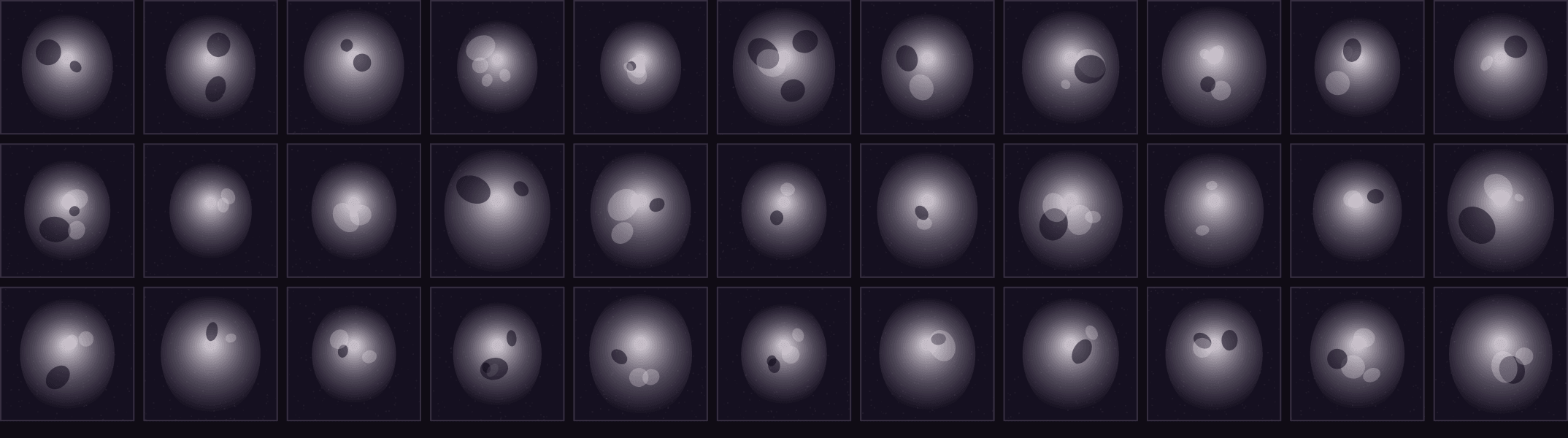
Grid of differential DNA methylation values, year on year
Fig. 02 — Differential methylation, year on year Pink: hypermethylated vs baseline · Teal: hypomethylated

DNA methylation across roughly a million sites in the genome changes with age in a patterned, partially reversible way. Second- and third-generation algorithms read that pattern to produce three distinct things, and it is worth keeping them apart: a biological age relative to your chronological age; a rate of ageing — how many biological years you are accruing per calendar year, which is the number that actually responds to what you do; and organ-system ages, which resolve the single number into components.

The reason to run it annually is the rate. A single biological age reading is close to useless on its own; a rate measured repeatedly against a fixed protocol is the only part of this assay class with a plausible claim to being actionable.

Where this sits in the hierarchy of evidence

These are not diagnostic tests and they are not regulated as such. Analytical reproducibility between runs, between laboratories and between algorithm versions is imperfect, and the outputs are sensitive to sample handling and to immune cell composition. Vendors themselves state that the results are intended to support rather than replace clinical judgement and should not be the sole basis for a diagnosis or a treatment decision — and this programme holds them to that. Epigenetic age is reported to you as one line in a much larger picture, labelled as research-grade, and it will never on its own start, stop or change a prescription. If it moves in the wrong direction while your ApoB, your visceral fat and your fitness are all improving, we believe the second set.

Structure

Imaging — annual whole-body MRI,
with everything else indication-led

Montage of diffusion-weighted whole-body MRI slices
Fig. 03 — Whole-body MRI, diffusion-weighted montage Non-contrast · No ionising radiation · Structured reporting
Whole body · annual

Whole-body MRI

Non-contrast, no ionising radiation, roughly an hour in the scanner. A multi-sequence protocol covering brain, neck, chest, abdomen, pelvis and spine, including diffusion-weighted imaging, which is what gives the study its sensitivity to cellular density and therefore to occult malignancy. Reported by a consultant radiologist to the ONCO-RADS standard rather than as free text, so that this year's study can be compared to last year's without ambiguity.

Cardiac

Coronary calcium and CT coronary angiography

A calcium score of zero in a person without symptoms carries a genuinely strong short-term negative predictive value. CTCA adds direct visualisation of non-calcified plaque, which the calcium score by definition cannot see, and modern quantitative plaque analysis characterises it further. Repeated only when the interval is long enough for change to be meaningful.

Skeletal and metabolic

DEXA

Bone mineral density with T- and Z-scores, plus regional lean and fat mass and an estimate of visceral adipose tissue. It also anchors the home body composition device, which drifts. Appendicular lean mass tracked across a decade is one of the more informative measurements in the whole programme, and the radiation dose is trivially small.

Hearing

Audiology, beyond the standard test

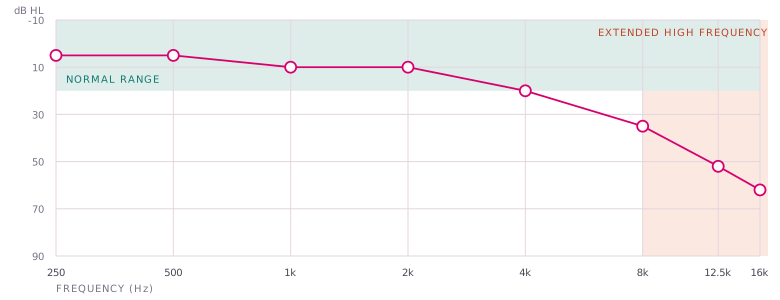
Pure-tone air and bone conduction, extended high-frequency testing above 8 kHz where early damage appears first, speech-in-noise testing, tympanometry and otoacoustic emissions. Hearing loss is a well-established, and partially modifiable, risk factor for later cognitive decline, and it is routinely measured too late and too crudely.

Audiogram showing normal hearing to 2 kHz and progressive loss through the extended high frequencies
Fig. 04 — Audiogram, right ear air conduction Illustrative · Shaded region: extended high frequency, where damage appears first
On imaging, honestly

Imaging asymptomatic people finds things. A meaningful proportion of those things are of no consequence but cannot be confidently dismissed without further investigation, which may itself be invasive and carries its own risk. That is overdiagnosis, it is real, and it is the principal cost of the whole-body MRI. No UK national screening programme recommends whole-body imaging of asymptomatic adults, and the published evidence base is observational rather than randomised — there is no trial showing that whole-body MRI screening reduces mortality. The programme includes it because it is non-ionising, because a stable annual series is far more interpretable than a one-off scan, and because a member of this programme has the clinical support around them to absorb an ambiguous finding without cascading into unnecessary treatment. That support is the actual product; the scan is an input to it.

CT and DEXA are different, because they use ionising radiation. Every such exposure is individually justified under the Ionising Radiation (Medical Exposure) Regulations 2017 by an entitled practitioner at the imaging centre, working to that centre's own employer's procedures. The programme does not offer routine whole-body CT to anyone. Cardiac CT is requested for a person, for a reason, and the reason is recorded.

Sight

The retina, imaged annually

Retinal vasculature branching from the optic disc, with the macula
Fig. 05 — Retinal vasculature and optic disc The only place in the body where small vessels and CNS tissue are directly visible

Intraocular pressure with corneal thickness correction, visual fields, dilated fundus imaging, and optical coherence tomography of the macula and retinal nerve fibre layer. The retina is the only site at which small vessels and central nervous tissue can be imaged directly, non-invasively, at micron resolution — which makes retinal vessel calibre and nerve fibre layer thickness informative well beyond ophthalmology. Tracked annually, they are among the earliest structural readouts of vascular and neurodegenerative trajectory available without a needle or a dose.

Surface

Skin, scalp and hair — the ageing
you can actually see

The most visible organ is also the most measurable, and it is routinely handled by the cosmetics industry rather than by medicine. This programme treats it as a clinical data stream: cancer surveillance first, then structure, then the systemic signals that show up there before they show up anywhere else.

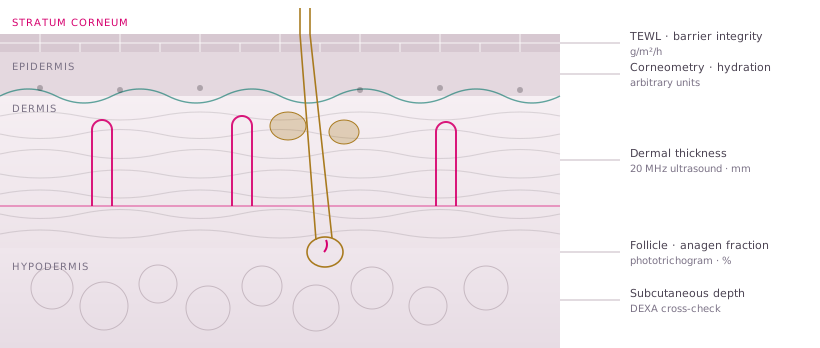
Cross-section of skin showing stratum corneum, epidermis, dermis and hypodermis with measurement callouts
Fig. 06 — What is measured in the skin, and at what depth Schematic · not to scale
Cancer surveillance
Total body photography with sequential digital dermoscopy, so that a lesion is judged against its own photograph from twelve months earlier rather than against a clinician's memory. Change over time is the single most useful signal in pigmented lesion assessment, and it is the one a first visit cannot give you. Suspicious lesions are referred for excision and histology — the programme photographs and monitors, it does not treat.
Barrier function
Transepidermal water loss and corneometry at fixed anatomical sites, which together describe how well the stratum corneum is holding water in and irritants out. Barrier decline is measurable years before it is visible.
Dermal structure
High-frequency ultrasound for dermal thickness and echogenicity, and cutometry for elasticity and recovery time. These are the closest available proxies for collagen and elastin condition without a biopsy.
Photodamage
Cross-polarised and UV photography to render subsurface pigment and vascular damage that ordinary light does not show, with melanin and erythema indices measured by colorimetry. Read against a documented sun exposure and phototype history.
Scalp and hair
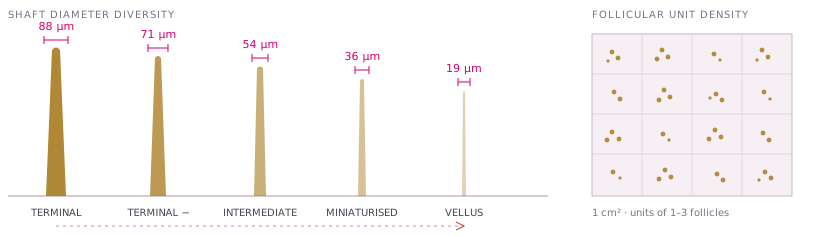
Trichoscopy of defined scalp zones and a phototrichogram giving hair density per square centimetre, the anagen-to-telogen ratio, the terminal-to-vellus ratio, and shaft diameter diversity — which is the measurement that detects miniaturisation before any thinning is apparent to you in a mirror.
Systemic linkage
Hair and skin findings are read against the same panel as everything else. Ferritin and iron studies, thyroid function, androgens and SHBG, vitamin D, zinc, insulin and IGF-1 all have visible cutaneous and follicular consequences, and a shedding pattern is frequently the first presentation of a deficiency or a thyroid change that the member had no other reason to suspect.
Hair shaft miniaturisation from terminal to vellus, with shaft diameters and follicular unit density
Fig. 07 — Miniaturisation, measured before it is visible Illustrative values · Diversity above roughly 20% is the conventional threshold
The limits of this, stated up front

This is dermatological and trichological measurement, not aesthetic medicine. No cosmetic outcome is promised, and nothing here is offered as a treatment for hair loss or for the appearance of ageing. Skin and hair are unusually confounded readouts: season, sun, sleep, stress, shampoo, recent illness and travel all move them, which is why fixed sites, fixed lighting and fixed intervals matter more here than anywhere else in the programme. Photography and dermoscopy reduce but do not eliminate the chance of a melanoma being missed; any new, changing or symptomatic lesion needs to be seen promptly whatever the last set of images showed. Where a prescription medicine is clinically appropriate for a scalp or skin condition, it is prescribed by our doctors with a documented consent conversation covering its side-effect profile, its evidence, and what would make us stop it.